Showing posts with label underground. Show all posts

Tuesday, 28 January 2025

Alice in Drains


Sometimes I do something a little different, and try to persuade the world that I'm an actual photographer, not just a maniac with a camera. And to do that, I usually find a real human, with a pulse and everything, to be a subject. But I keep it urbex-related just because that's where I'm at my happiest. 

This is my second time working with Alice in this capacity. Alice is a photographer and accomplished urbexer in her own right. She taught me how to actually use a camera, and I in turn didn't get her killed when we used an air vent to access an abandoned tower with a six-story drop. Alice does an entire photographic series of portraits with a creepy rabbit head, so we decided to combine our themes. We've done it on the rooftops before, admittedly to a more superior quality than I have done with this. But the rooftops are easy. This is my first time photographing someone underground, with no natural light. 


Well, except here. But this is the tunnel entrance. 
To be clear, this is not a sewer. Many, many years ago it was an actual river, and the powers-that-be decided they wanted Shrewsbury to be there instead, and quietly shunted it underground. It's possible to access this tunnel from both openings, one upstream and one downstream, and sometimes it's possible to see frogs and fish living down here, completely unaware that sunlight even exists. 
But of the risks involved here, we can probably rule out the likes of campylobacter, giardiasis, or methaemoglobinaemia, which is terrific. I don't want anything entering my body unless I can pronounce it. 
It's a good thing I can pronounce penis.

Truthfully this whole photoshoot thing is a little bit silly, but then when something like this is right on your doorstep, you've exhausted the exploration of it and documented it to completion, what's left to do but have fun with it? Because first and foremost a hobby should be fun. You remember what fun is, right? I know this is the era of Facebook, where we're just expected to stand around lugubriously and complain about vegan sausage rolls, other peoples genitalia, and a bunch of other shit that doesn't really matter, but out here in the real world the whole point of life is to have fun. 


To be honest, despite having no natural light in this subterranean playground wrought with hazards and possible death, these came out alright. It's almost like I know what I'm doing.

I don't. It's *like* I know. 


As a quick disclaimer or cautionary warning, exploring structures like this is very dangerous. It's a passage of flowing water, with numerous drains joining on, and if there was any sudden heavy rainfall this place can quickly become a literal death trap. There are real cases of urban explorers dying in storm drains. The water can get pretty fast, the floor can be pretty slippery, and there may be debris flowing along and other hard things to whack your head on. I don't go underground unless it's been a dry day. There's no phone signal and no natural light, so if something goes wrong, it can go VERY wrong. 

 
I can't speak for Alice, although we are on the same page about a lot of stuff, but I sort of envision her rabbit character as a type of cryptid, or slenderman-ish entity that is glimpsed but never actually interacted with. People may see it, but if they turn their head or blink, the rabbit will be gone, vanished in a puff of someone else's problem. 


Naturally I will conclude with one of Alice's photos of me wearing the rabbit head.
 

It's pretty cool. Obviously Alice is a superior camera person to me, but the entire shot in contrast the opening shot also shows what difference a wide angle lens can do. I was very jealous. 

And that's about it. It's just a small one before I start focusing on my travel blog again. I have something kinda big coming up, which is great because my recent posts here have all been kinda small.

If you like my blogs and want to stay updated, then unfortunately social media is the best way. Because the big ones (Facebook and Twitter) are all algorithmic hellscapes with more bots than fleshbag humans, that seem to serve only to bait us into arguments. I'm trying to focus my energy more on the likes of Bluesky, Vero and Cara. Social media does need to change. The internet was never intended to be the misery factory that it has devolved into. It needs to be about sharing creativity and hobbies, whether that's photography, art, writing, or even showcasing a collection of something. That's the internet I want. So definitely give those last three a chance if you fancy taking social media in that direction.

Thanks for reading!

Sunday, 28 April 2024

Cave Restaurant

 
One lovable fact about history that I've had to face year after year of doing this blog is that the Victorians were fucking bonkers. In some parts of Shropshire that fact is driven home by a little bit more than the usual adorable follys and bookcase doorways. Instead we have cave dwellings, where people literally lived underground. This particular cave is said to pre-date the Victorian era, but it was around the 1850s that historic records start referring to it as a restaurant, and that is kinda nuts. I love it.
 
The cave was likely excavated in 1804 or 1805, simply because the bridge leading over to it was built on the 13th December 1804.
 
 
And it looks pretty good for something that's not been maintained for over a century. Old maps show the road over it leading directly to the cave, but there's no road anymore. If it wasn't for this very obvious bridge, there would be no clues it was ever here at all.
 
 
The bridge ends and the woods begin. 
 

 And to look at this cave, it's so completely covered in brambles and ivy that in the summer it's probably impossible to see. But before it was all overgrown, it would have been pretty scenic around here. According to the groundskeeper, a small bus would bring people here for refreshments in a nice woodland setting with a view of the river. I'm going to assume, based on the size of the cave itself, that many of the seats were outdoors, and I'm going to assume that the bus was a horse-drawn bus that would fit maybe six people at a time, although 1820s horse buses were known to fit up to sixteen passengers in fancier places like Paris, so who knows? Either way the trip out to this place would have been as pleasant and relaxing as actually being here. It made for a nice chilled day out.
 
Allegedly there's an outdoor toilet somewhere around here too, hidden under a mess of brambles near the cave. It's impossible to see now, but I assume it's still in better condition than the toilets in some pubs and clubs.

 
Slipping inside, it's easy to see where the original doorway was. It's still got its wooden frame. The inner walls are still partially covered in lime wash paint, but the floor is buried under a couple feet of dirt that's blown in over the last hundred years or so. I do wonder if there are any Victorian floor tiles lost under here somewhere.
 

One wall of the cave is open to the elements, and I'm not sure if that's intentional or if the sandstone wall has fallen away over time. I think if the restaurant was meant to be open like this, it wouldn't need a door. But it's very possible that there was a brick structure attached here once, and that this has been taken down. It's very rare that these cave structures were all cave. Usually the caves were simply incorporated into an actual building.
 

There's a little alcove here which quite possibly once had a little table and a couple of seats in it. It would be cute if the ceiling hadn't recently picked that exact spot to drop itself. 

Hmm... maybe I should keep this mooch quick.


So next to the main entrance door is an archway leading deeper into the cave.
 
 
So as far as historic documents go, it's actually the diary of Adelaide Darby that provides the most information about this place. But even that is a surprising source. Adelaide Darby is the grand daughter of Abraham Darby. She's also the great-grand daughter of... another Abraham Darby. And the great-great-grand daughter of... another Abraham Darby! Seriously, coming up with baby names is not this families strong point. But it was Adelaide's Grandfather who built Ironbridge's titular iron bridge, so they were pretty damn rich. She was also married to a politician, Henry Whitmore, who was the MP for Bridgnorth, and he's also been in this cave.

So it's interesting because you'd think something like a cafe operating out of a cave would cater more to the working class, but two of the regular patrons are a couple of rich folks from a nearby mansion.

The first mention of it is in Adelaide's diary entry from January 1853, when she mentions that she goes to "The Cave" with her friend Emily, who is the second daughter of Charles Whitmore, a rector at Stockton and no doubt a relative of Henry.
 
 
Henry Whitmore himself came here "for lunch" on the 17th October 1855, where he met with a mysterious gent called Mr Bluck. Adelaide and Henry seemed to do just about everything with Mr Bluck. He was their lifelong companion and presumably someone employed by them in some capacity. 
It's this diary entry that elaborates that "The Cave" was an eatery, and it even specifies its location, matching up with this one.

Adelaide doesn't really talk much more about it though. Her journal was more vocal of her opinions prior to her marriage, after which it became more an endless listing of where she went and who with. She was a busy woman. 

She mentions coming here twice more, once in September 1856 for tea, and again in September 1857, this time bringing her mother, Henry, Mr Bluck and her dog Toozie. Toozie was a bit of an escape artist, with many a journal entry despairing about how he was missing, only to be returned by the servants a few days later.
 
 
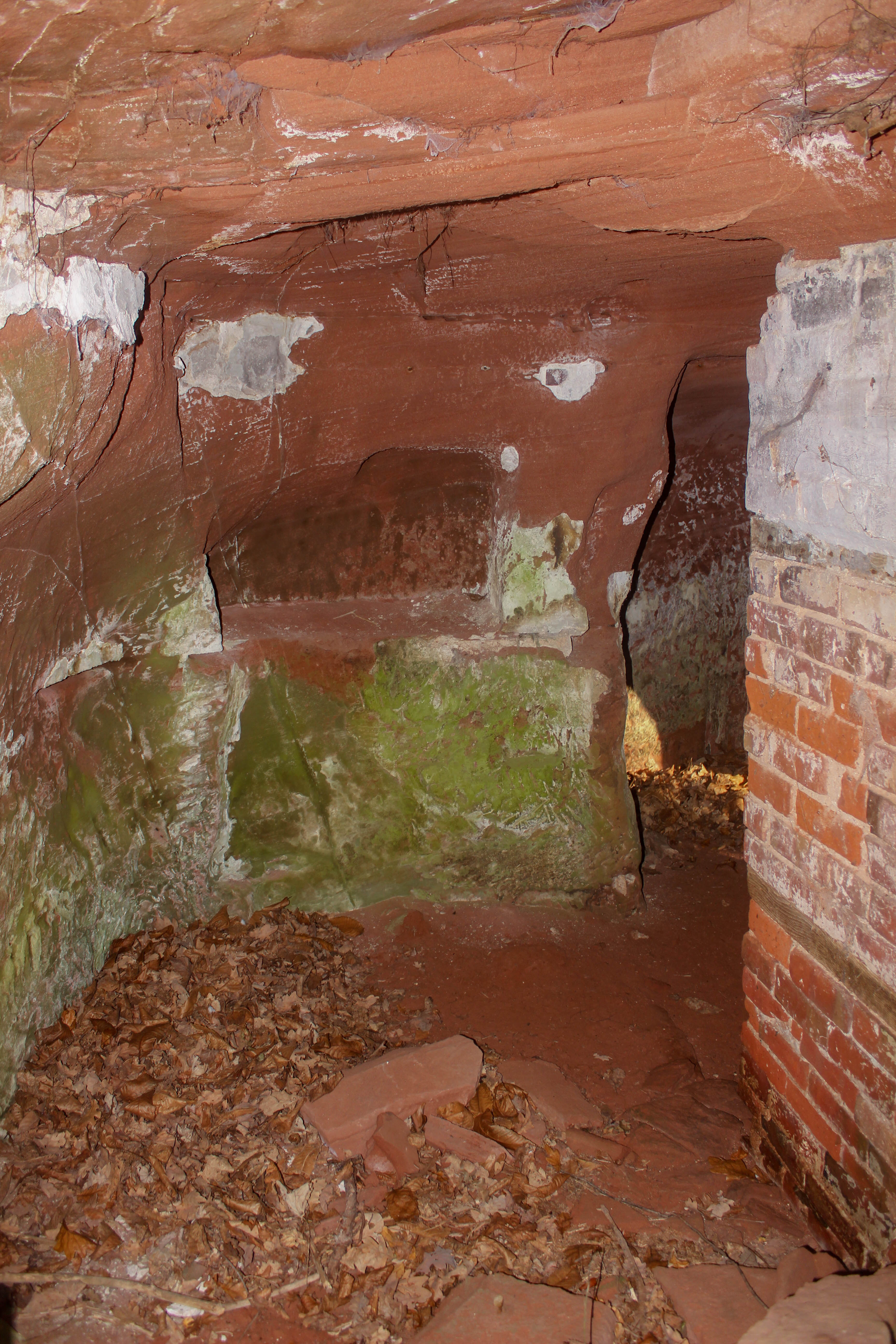
This deeper room of the cave has a raised platform that still has the remnants of some tiles on it. But was this a seating area? Because if food and drink was served here then one of these rooms had to be a small kitchen, and this one makes the most sense. It probably wasn't anything too extravagant, but if one supposes the actual floor of the cave is beneath a load of dirt, then it's entirely possible that these seat-level platforms are actually work surfaces. This could well be the area where food was prepared. I wish I knew exactly what. Maybe it was just sandwiches and salad.
 

 The walls of the cave are full of these square slots, which would have had either lamps or beams.
 

I presume there would have been a small Victorian stove in here. I'm not sure quite what the logistics are when it comes to operating a cafe out of a cave. But if one looks closely against the bottom of the rear wall, there are some symmetrical indentations that suggest that something was there. And if one looks at the upper wall on the right, there are some horizontal gashes where shelves used to be too. 

But what's really interesting is the graffiti. I'm going to focus rather heavily on it, because it's awesome and there is a lot of it. Starting with the door frame itself...

 
There's a bunch of scribbles here, one of which is dated 1939.
 
 
And here we have "MJC, Lord of the Manor, 6th April 1952." 
These initials don't match up with anyone from the nearest manor around this time, so I have no idea who this could be.
 
 
There's a few declarations of love here. And on the walls of the cave, the graffiti continues. 
 
 
John Matthews, in 1946, wrote his full address on the wall.


William Matthews of Norton, October 1st, 1942.
This looks like a child's handwriting. It's really incredible how all of this is preserved, but also that this cave got so much attention. Was it so hidden that by the 1940s it became something of a hidden gem to be sought out? What was it about this place that made everyone want to brag that they'd been here?
I'm not complaining. I think this is epic. I'm just a bit bewildered.
 

There's one here from 1935.

 
Fred Norgrove, 15, wrote in 1969 "I'm always for a bit of nice stuff."
 
 
R Mitchell was here squirrel shooting.


And someone from Walsall wrote his entire address on the wall in 1938. 


There's one here from 1665, but given that it's written in pencil and would predate the cave itself, I think that's just someone being facetious. 


There's some graffiti here claiming to be from the projectionists of one of the "Carry On" movies in 1967. Unfortunately I can't figure out which movie that is, because the final word is slightly faded.
Carry on Heroin?
 
 
There's one here from 1905. 


One from 1923.
 

And finally Eddie Cooke, in 1954, wrote "Anyone who reads this, write to..." and then he lists his full address, which has now faded away, although "Bridgnorth" is still visible. I did do some digging and found that he was born in 1935, so we can assume that he's probably not living at the address listed anymore. In fact it's highly possible that he's not living anywhere anymore. But just in case, please make no attempt at contacting him or anyone else who have listed their address on this cave. I do this to document history, not facilitate harassment.
 
It's amazing though. What we've done here is inadvertently stumble across a lost legend. Clearly this cave mattered to a lot of people throughout the years, as some sort of lost point of interest that they should totally consider an achievement for finding. Evidently they didn't have the benefit of the internet, so they probably pottered about in the woods for ages while the cave itself was buried under ivy and brambles. 
It's amazing that all this vintage graffiti still exists. This is some real history.

And it's amazing that before it became covered in the graffiti of those bragging that they found it, this place was a haunt of the likes of Adelaide Darby and her husband, Henry Whitmore, MP of Bridgnorth. And countless others probably came here to sit and enjoy the scenery over a cup of tea. It must have been quite nice back in its day.

To conclude, I do need to stress that the ceiling is collapsing in here so entering is probably not the smartest idea anymore, but I would love to return with a wide angle lens. It's very temporary. It should be documented while we have it.
In the meantime, if you like my blogs then you can follow me on social media platforms. I'm on Instagram, Facebook, Vero, Reddit, and the silly ones, Twitter and Threads
Thanks for reading!

Tuesday, 9 April 2024

Cave House

 
When one considers cave dwellers, the common mental image is our prehistoric ancestors, unless we're making a jab at someones IQ (Troglodyte is a fantastic word, and we should definitely use it on stupid people) but in Shropshire some people were living in caves less than a century ago, and for some reason I'm absolutely fascinated by it. I've documented cave dwellings before and often found them tricky to locate because they show up on old Victorian maps as actual houses. And that does make a little bit of sense because the caves themselves are actually incorporated into houses in a curious amalgamation of natural rock and masonry. My last blog on cave dwellings didn't really capture that because there wasn't much brickwork left, but today we're lucky.
 
 
There are a few caves around here, and locals seem to know stories about each one, but with the pitfall that nobody seems to be able to agree on which nugget of history can be attributed to which cave. 
I have read that in 1809, a man did find human skeletal remains in one of the caves, and that these were regarded as some sort of ritualistic killing, but I don't know if that was this particular cave. Either coincidentally or in reference to it, the TV presenter Griff Rhys Jones did camp out here and perform a mock druid ritual during his series on British rivers. I haven't found the episode in question, but it sure sounds intriguing. 

This cave was probably adapted to a dwelling at some point after 1804, when the access road was created.  But now, there's barely any sign of there being an access road at all. There's a pretty nice bridge, but it's now regarded as more of a folly because it doesn't lead anywhere! The road it once attached to is gone.

 
The bridge itself is somehow still structurally sound despite being without maintenance for nearly a hundred years. Actual historic documents put its date of construction as the 13th December 1804, while Victorian maps show that the road that once ran over it did fork off, with one such path leading right to the cave house.
 

But it is possible that the cave was being occupied even before that. There's a letter to the wealthy landowners, dated 10th February 1793, that says "The old woman Hemmings who lives in the cave lately occupied by your shepherd requests to teach school there. She says she is both old and lame and cannot get a livelihood as formerly, but could instruct the poor children of the neighbourhood."
 
A follow-up letter from the 16th April 1803 tells of how the cave ceiling collapsed and broke poor old Hemmings furniture. But no children!
 
Somehow I don't think that's the same cave. This one doesn't have a collapsed ceiling. But such documents do prove that people were living in caves in this area. Poor Miss Hemmings was a lonely old lady who could hardly walk, and she wanted to use her cave as a place to contribute to society anyway and maybe have something to do with her time.
 
 
There is an image that is alleged to show this house before it was abandoned, but it's worth noting that the image is also alleged to be a completely different house some distance away. I'll include it anyway just in case.
 
(Photo not mine, obviously)

I can see the resemblance, and it clearly does back up onto a rockface. However I'm not entirely convinced. The windows and doors don't quite match up with what's left.
 
 
So for something a little more conclusive, census data does list a family that lived here, that being James and Ann Syner who came here at some point after their marriage in 1840. The 1841 census mentions the newlyweds in their twenties, living at another part of Shropshire, but at some point between that and the 1861 census, they seem to have moved here to raise their collection of semen demons. 

That particular census lists James as a gardener, along with their eldest son Henry, and Ann as a housekeeper. So it would seem that they got jobs on this wealthy estate, and the rich folks at the mansion said "We can't give you an actual house to live in... but would you like to try out our cave?"
 
The Syners had six children here in total, one of which died in infancy. I managed to find a photo that depicts the youngest daughter, Annie, with her mother Ann and their grandfather, sat outside the entrance to their cave house.
 
(Photo not mine, obviously)

According to the 1901 census, little Annie pictured here would go on to become a servant for a surgeon named Alfred Bethell. The 1881 census shows Ann and James living here alone, as their children had all grown up and got married. Ann would pass away in 1887, and in the 1891 census James is said to be living here with his granddaughters, Edith and Agnes. He's in his seventies and he's still a garden labourer, which is pretty impressive. And in a way, it's kinda wholesome that his granddaughters came to stay with him after his wife passed away.

James passed away in 1899, and Edith would go on to become a cook for a surgeon called John Pazley Cadwick, while Agnes similarly went on to become a servant for a woman named Annie Mallinson. 
I actually really enjoy these dives into the history of lower-class Victorian families. It's always the rich and famous who get a Wikipedia page. It's kinda nice that I can immortalise the little people too.

 
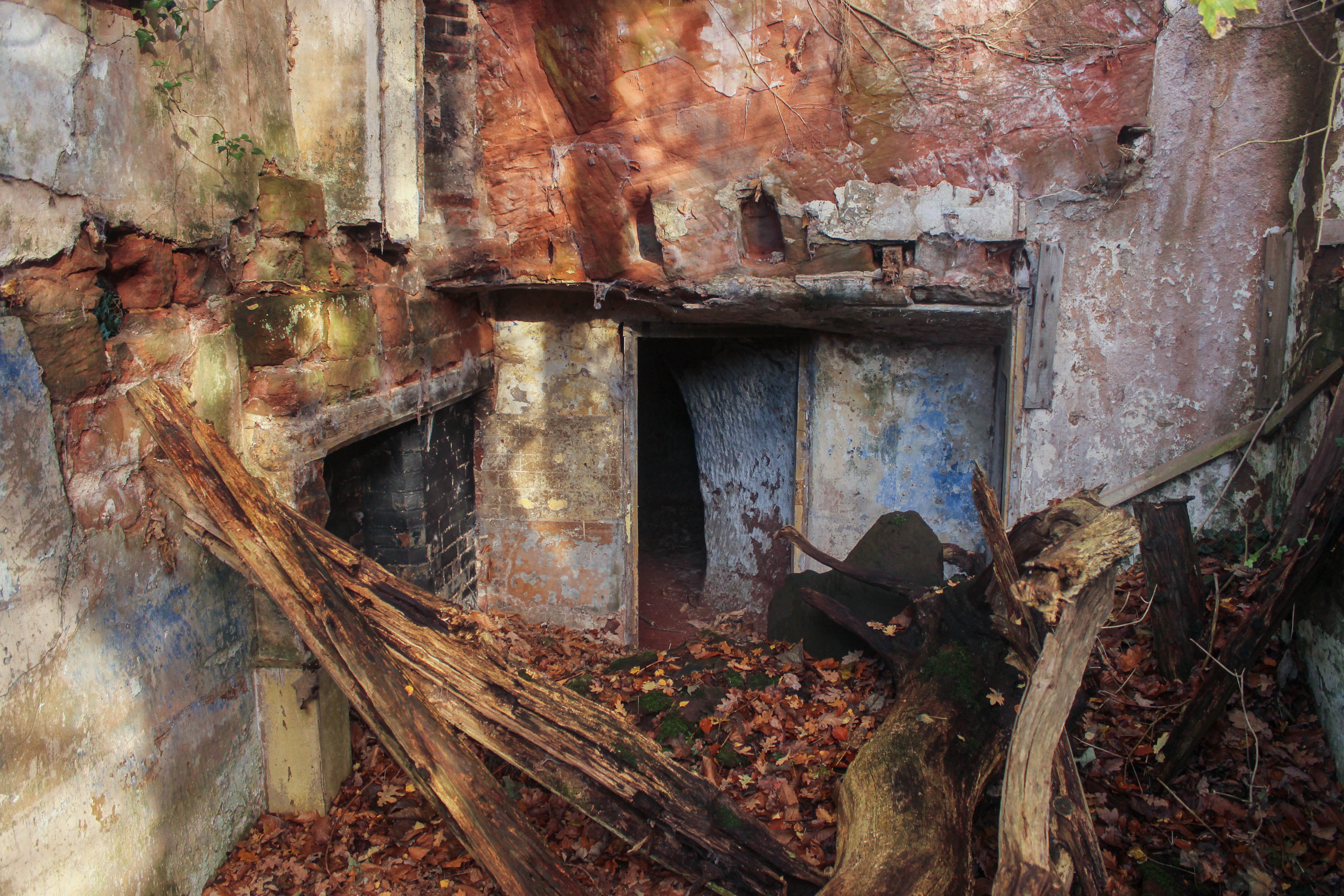
Among the ruins we can see how the brickwork of the house was connected to the cave walls. I find this sort of thing really interesting. A lot of effort went into creating this place.
 

There's a tiny chunk of roof tiles still here too.  
 
But it's time to check out the interior!

 
I assume this would have been the front room of the dwelling. There was quite clearly an upstairs living space at some point, but it's long since collapsed.
 

 At the back of this "room" is the cave entrance, still intact. I actually love this. There's just something wonderful about having a house with a secret cave attached.
 
 
There's a fireplace here, and it also seems to be sharing a chimney with a smaller fireplace on the upper floor. 
 
 
It's partially crumbled away but still kinda cute. 
 

 Time to check out the cave itself!
 

So regarding the census data of the Syner family, it's important to note that while I'm reasonably sure that this was their house, I can't be 100% sure. There is another cave structure nearby that might also be a contender, but a groundskeeper claims that it was actually used as a small restaurant. This is verified by the diaries of Adelaide Darby, the wife of one of the rich folks from the estate. She wrote briefly about going to a restaurant on the grounds that was built into a cave. This was in the 1850s, so James and Ann Syner were quite possibly here at the same time, and I really can't see people who were lifelong garden labourers and housekeepers also running a cafe. They must have been separate structures.
 
Having said that, I only know definitively that they were here as of 1861, so it's entirely possible that they lived in the same building, and the restaurant closed when they arrived. But somehow I doubt it. The 1861 census showed that they had a multitude of children, ranging from nineteen to infancy. They were settled in. 

I think the Syner cave and the cafe cave were definitely different. It's just a question of confirming which was which out of the two. Personally I do think this one is probably the Syner cave because the other is way too prominent on the old Victorian maps, indicating a wider use than just a dwelling. The road leads right to it from the bridge, whereas this one is down a little side route.
 
 
The cave portion of the house is basically just the kitchen. That might sound kinda odd from a hygienic standpoint, but it does actually make sense. Nobody had fridges yet, so food was commonly kept underground to keep it cool. In that way, the cave house kitchen kinda doubled up as an ice house.


There's a little tap here over the remains of a sink. Clearly the house had running water at some point.
 
 
There's a cute little pantry area here. 

 
I don't know who lived here after the Syner family left, assuming this was their cave. But in a curious twist, I have heard that the descendants of Old Tom Parr lived in this area. I cannot verify if they lived in a cave or in an actual house, but it's worth telling the story of Old Tom Parr anyway, because it's awesome.
 
Old Tom Parr was something of  Shropshire Methuselah, being born in 1483 and dying in 1635 at the age of 152. Now, it's commonly believed and incredibly likely that there was some record-keeping error at play here, but this isn't just something that was lost to history. This was widely believed even when he was still alive. Tom was even showcased to King Charles I as a "curious piece of nature." 

Tom had had his first wife at the age of eighty, and was found guilty of fathering a child during an affair when he was 105. He then married again at 122.

Then he was taken to London to meet the King, and his health just rapidly deteriorated. The King asked him that if he had lived longer than other men, what had he done more than other men, at which point Tom started talking about all his affairs.
 
I kinda gotta love the guy for that. There aren't many people who would get an audience with the King and start talking about all the times they got their dick wet.
Tom Parr died shortly after arriving in London. That's fair. 

As for his descendants, a Margaret Parr did live in the area, and she married a Benjamin Rowley. The Rowley's took their name from the nearby hamlet of Rowley, but they were mill owners and did pretty well for themselves. One of the Rowleys was the first person in Shrewsbury to own a carriage. I can't really see such a family living in a cave. But still, it was worth going into just to talk about Old Tom Parr.
 
 
This cave house was last occupied in the late 1930s, but I don't know who by, why they left or when the house fell into disrepair. It likely doesn't have much of a future, unless someone invests a load of money into restoring it for some reason. But as far as ruins go, it's kinda cute. It's just this little slice of everything that was brilliantly bollocks about the Victorian era. I absolutely love stuff like this. But it must be stressed that anything involving underground stuff is incredibly unsafe. This thing is liable to collapse at any time. 

That's all I've got for now, but if you do enjoy the blogs, then the best way to stay updated with them, unfortunately, is via social media. I'm mainly on Instagram and Facebook, but also Vero and Reddit when I remember they exist, and sadly Twitter and Threads too.
Thanks for reading!